
Showing posts with label PALESTINE MON'AMOUR. Show all posts
Showing posts with label PALESTINE MON'AMOUR. Show all posts
Saturday, October 9, 2010


Wednesday, September 22, 2010
One Palestinian killed and five others wounded in clash with Jewish settlers in Silwan neighbourhood.
| East Jerusalem clash turns deadly | |||||
|

Arrests, Violence and one small Victory - Weekend demonstrations during Yom Kippur in the West Bank
Al Ma'asara

Some thirty Palestinian, Israeli and international activists gathered this week in Ma'asara to protest against the Apartheid Wall. The small procession passed through the village, and was met by a gang of soldiers and border policemen at its outskirts. The soldiers declared the area was a closed military zone, and allowed the demonstrators a minute to leave.
One of the demonstrators started giving a speech about the anniversary to the Sabra and Shatila massacre, and the soldiers reacted by throwing stun grenades at people's feet. Two minutes later they started throwing tear gas as well. Demonstrators took a step back, then returned forward, and were met with more violence. Demonstrators put their hands up in the air, calling soldiers not to shoot at the non-violent demonstration, and to use the Jewish holiday of repentance to rethink their actions. This repeated itself for some twenty minutes, until the soldiers suddenly left. Demonstrators celebrated their small victory, and the demonstration was over
One of the demonstrators started giving a speech about the anniversary to the Sabra and Shatila massacre, and the soldiers reacted by throwing stun grenades at people's feet. Two minutes later they started throwing tear gas as well. Demonstrators took a step back, then returned forward, and were met with more violence. Demonstrators put their hands up in the air, calling soldiers not to shoot at the non-violent demonstration, and to use the Jewish holiday of repentance to rethink their actions. This repeated itself for some twenty minutes, until the soldiers suddenly left. Demonstrators celebrated their small victory, and the demonstration was over
Ma'asara
Big anti-Israeli demonstration in Paris
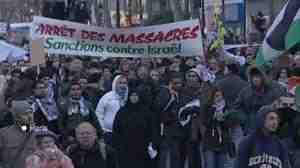
Monday, September 6, 2010
Friday, 03 September weekly demonstrations
04/09/2010
or t. A group of around thirty protesters reached the wall route after a shor t march through the village's lands. One of the protesters called on the soldiers to stop defending the theft of Ni'lin lands. One or two protesters threw some stones over the wall, and some tires were set fire to. Within a minute of this, soldiers fired a volley of tear gas canisters, and shor tly after, crossed the barrier in pursuit of the demonstrator s, who retreated back into the village. Two international protesters were grabbed by soldiers and held for around half an hour, but they were then released and returned to the village.
Bili'n
Some 10 Israelis and a handful of internationals joined this Ramadan's last Friday demo against the wall and the occupation in Bil'in. With the heat and fasting taking their toll, and the international delegations season over, the demo was smaller than usual. The army set a barbed wire barrier on the way to the wall, and deployed a few dozen meters behind it, between the wall and the barrier. The demonstrator s gathered behindthe barbed wire, and after a few minutes removed it to march for ward) next week, will they set a new barrier to protect the barrier that is supposed to keep demonstrator s away from the wall?). At that point the army started shooting gas, and the demonstrator s had to retreat and
declared the demo over. While even some of the feistier shabab couldn't be bothered to throw stones, the army kept on shooting gas until all demonstrator s were far up the hill leading to the village, occasionally getting some gas "blow back" due to the shifting winds.
declared the demo over. While even some of the feistier shabab couldn't be bothered to throw stones, the army kept on shooting gas until all demonstrat
Ni'lin
Some thirty Palestinians, Israelis and internationals participated in Friday's demonstration in the village of Al Maasra
Soldiers, who jumped off the vehicles as they wave their guns, declared the area a closed military zone and began pushing the protesters away while throwing stun grenades. One grenade was thrown directly at one of the demonstrator s, hitting his body befor e falling and exploding on ground.
After pushing demonstrator s to the junction outside the closed military zone, the soldiers began to back off. Demonstrator s decided to move for ward again. After a shor t distance, the soldiers pushed back the demonstrator s to junction, using tear gas and stun grenades. At This point, occupation for ces left the area and demonstrator s declared victor y. befor e the end of the demonstration was announced, Arabic and English speeches were made, denouncing the occupation, and calling for freedom, justice and implementation of international law.
DESERT BASE LISTENS TO THE WORLD TALKING

Israel’s Urim base in the Negev desert is among the most important and powerful intelligence gathering sites in the world. Yet, until now, its eavesdropping has gone entirely unmentioned
BY NICKY HAGER
Israel’s most important intelligence-gathering installation is only a 30km drive into the Negev desert from Beersheba prison – where those taking part in the Gaza aid flotilla were briefly detained this June. The base, hidden until now, has rows of satellite dishes that covertly intercept phone calls, emails and other communications from the Middle East, Europe, Africa and Asia. Its antennas monitor shipping and would have spied on the aid ships in the days before they were seized.
Israel’s powerful position in the Middle East is often associated with its armed forces, nuclear weapons arsenal or covert (Mossad) operatives. But just as important is its intelligence gathering – monitoring governments, international organisations, foreign companies, political organisations and individuals. Most of this happens at the installation in the Negev a couple of kilometres to the north of the kibbutz of Urim. Our sources, close to Israeli intelligence, know the base first-hand. They describe lines of satellite dishes of different sizes, and barracks and operations buildings on both sides of the road (the 2333) that leads to the base. (more on cryptome.org)
Sunday, September 5, 2010
General news from free palestine...
Trial in Death of Rachel Corrie Resumes in Israel 5/9/2010
Netanyahu: What is Said and What is Not 4/9/2010
The historical origins of the Iranian Revolution and the tasks of the Revolutionary Marxists – Part Three 4/9/2010
Video:Jerusalem Bondage 4/9/2010
In Picture:A history of talks and violence 2/9/2010
28-31/10/2010: World Education Forum in Palestine 27/8/2010
PA to introduce austerity measures 27/8/2010
Imbalance of Power, the Middle East Problem 27/8/2010
Netanyahu: What is Said and What is Not 4/9/2010
The historical origins of the Iranian Revolution and the tasks of the Revolutionary Marxists – Part Three 4/9/2010
Video:Jerusalem Bondage 4/9/2010
In Picture:A history of talks and violence 2/9/2010
28-31/10/2010: World Education Forum in Palestine 27/8/2010
PA to introduce austerity measures 27/8/2010
Imbalance of Power, the Middle East Problem 27/8/2010
Saturday, September 4, 2010
Mass arrests, clashes follow settler shootings
Report, The Electronic Intifada, 3 September 2010
On 1 September the Palestinian Authority's (PA) security forces launched an unprecedented arrest campaign against Palestinians affiliated with the Hamas party in the occupied West Bank. The arrest sweep followed attacks earlier in the week against Israeli settlers in Hebron and Ramallah.
The PA's Preventative Security Services and the General Intelligence Services arrested and detained at least 350 Palestinians from all West Bank governorates, according to a press release from the Palestinian human rights group Al-Haq.
Four Israeli settlers from the Beit Hagai settlement were killed on Tuesday evening near the city of Hebron, when they were shot dead while driving on Route 60, the highway that connects Jerusalem to the settlements in the southern occupied West Bank. Approximately 24 hours later, two Israeli settlers were shot and injured in their car while driving near Ramallah and the Kochav Hashachar settlement.
The al-Qassam Brigades -- Hamas' armed wing -- claimed full responsibility for both attacks, according to Ma'an News Agency. Ma'an reported that the al-Qassam Brigades released a subsequent statement describing the shootings as a "normal and legal response to Zionist aggressions on the Palestinian civilians" and "part of the repelling operations against the occupation assaults on the Gaza Strip and West Bank" ("Hamas claims Ramallah attack," 1 September 2010).
Al-Haq says that the Palestinian Authority's arrest campaign against individuals affiliated with Hamas across the West Bank was "executed without the proper arrest warrants" and violated several laws related to arrest and detention rights and procedures.
"The total number of persons arrested without a legitimate warrant is likely to be significantly higher," Al-Haq added. "However, it is not possible to obtain an exact figure of the detainees as no record is being kept of persons detained and released within 24 hours. Hundreds of people currently remain in detention."
On Thursday, 2 September, Israeli daily Haaretz reported that the PA detained an additional two Palestinian men from the Hebron area, alleged by the PA to be in connection to Tuesday's attack ("Palestinian authorities: We're arrested two suspects ...").
The settler shootings and the heavy crackdown on Hamas supporters comes as US-brokered direct talks are taking place between the Palestinian Authority and Israel in Washington, DC. All opposing Palestinian political parties, including Hamas, have been disallowed by the PA from participating in the negotiations process. Last week, PA forces interrupted and dispersed a conference in Ramallah, attacking dissenting political officials and activists.
Al-Haq stated that "the sweeping and arbitrary nature of the arrests of political opponents demonstrates that these measures are fueled by political expediency as opposed to genuine security concerns. In fact this campaign is part of a pattern of oppressive policies adopted by the Palestinian Authority to stifle political dissent and to generate a sense of intimidation within Palestinian society."
The group added that it "condemns this arbitrary use of power by the Palestinian Authority and reiterates that the rule of law and the fundamental rights of individuals must not be sacrificed on the altar of political interests."
Meanwhile, in the occupied East Jerusalem neighborhood of Silwan on 1 September, hundreds of demonstrators, including Palestinian residents of Silwan and Israeli and international activists, confronted attendees of a conference aimed at promoting "archeological" interests in the neighborhood.
An increasing number of Israeli settlers have regularly taken over Palestinian homes in Silwan, under the cover of an Israeli archaeological institution, Elad, which has led the charge to push Palestinians out of the area and re-brand Silwan as the "City of David." Elad was the sponsor of Wednesday's conference in Silwan.
Journalist Joseph Dana reported on his website that Israeli border police and special forces, called Yasam, "were deployed and allowed to use physical violence to prohibit the protesters from getting close to the entrance."
"The protest stayed completely nonviolent as Yasam forces repeatedly attacked protesters, threw them to the ground like rag dolls and arrested them," wrote Dana. "At one point, a settler literally drove his car through the protest, almost running over a number of people" ("Israel vs. Israel ...," 2 September 2010).
Wednesday's demonstration follows previous clashes and arrests in Silwan last week. On Monday, clashes broke out when Israeli municipal police, border police and intelligence officers raided several neighborhoods in occupied East Jerusalem, arresting and detaining Palestinians accused of participating in clashes the previous week, according to Ma'an. Residents of the neighborhood reported that last week's clashes began after Israeli settlers broke into the local al-Ein mosque on 26 August ("Clashes reported in Silwan," 30 August 2010).
 |
| Israeli police arrest demonstrators at a protest in Silwan, occupied East Jerusalem. (Oren Ziv/ActiveStills) |
On 1 September the Palestinian Authority's (PA) security forces launched an unprecedented arrest campaign against Palestinians affiliated with the Hamas party in the occupied West Bank. The arrest sweep followed attacks earlier in the week against Israeli settlers in Hebron and Ramallah.
The PA's Preventative Security Services and the General Intelligence Services arrested and detained at least 350 Palestinians from all West Bank governorates, according to a press release from the Palestinian human rights group Al-Haq.
Four Israeli settlers from the Beit Hagai settlement were killed on Tuesday evening near the city of Hebron, when they were shot dead while driving on Route 60, the highway that connects Jerusalem to the settlements in the southern occupied West Bank. Approximately 24 hours later, two Israeli settlers were shot and injured in their car while driving near Ramallah and the Kochav Hashachar settlement.
The al-Qassam Brigades -- Hamas' armed wing -- claimed full responsibility for both attacks, according to Ma'an News Agency. Ma'an reported that the al-Qassam Brigades released a subsequent statement describing the shootings as a "normal and legal response to Zionist aggressions on the Palestinian civilians" and "part of the repelling operations against the occupation assaults on the Gaza Strip and West Bank" ("Hamas claims Ramallah attack," 1 September 2010).
Al-Haq says that the Palestinian Authority's arrest campaign against individuals affiliated with Hamas across the West Bank was "executed without the proper arrest warrants" and violated several laws related to arrest and detention rights and procedures.
"The total number of persons arrested without a legitimate warrant is likely to be significantly higher," Al-Haq added. "However, it is not possible to obtain an exact figure of the detainees as no record is being kept of persons detained and released within 24 hours. Hundreds of people currently remain in detention."
On Thursday, 2 September, Israeli daily Haaretz reported that the PA detained an additional two Palestinian men from the Hebron area, alleged by the PA to be in connection to Tuesday's attack ("Palestinian authorities: We're arrested two suspects ...").
The settler shootings and the heavy crackdown on Hamas supporters comes as US-brokered direct talks are taking place between the Palestinian Authority and Israel in Washington, DC. All opposing Palestinian political parties, including Hamas, have been disallowed by the PA from participating in the negotiations process. Last week, PA forces interrupted and dispersed a conference in Ramallah, attacking dissenting political officials and activists.
Al-Haq stated that "the sweeping and arbitrary nature of the arrests of political opponents demonstrates that these measures are fueled by political expediency as opposed to genuine security concerns. In fact this campaign is part of a pattern of oppressive policies adopted by the Palestinian Authority to stifle political dissent and to generate a sense of intimidation within Palestinian society."
The group added that it "condemns this arbitrary use of power by the Palestinian Authority and reiterates that the rule of law and the fundamental rights of individuals must not be sacrificed on the altar of political interests."
Meanwhile, in the occupied East Jerusalem neighborhood of Silwan on 1 September, hundreds of demonstrators, including Palestinian residents of Silwan and Israeli and international activists, confronted attendees of a conference aimed at promoting "archeological" interests in the neighborhood.
An increasing number of Israeli settlers have regularly taken over Palestinian homes in Silwan, under the cover of an Israeli archaeological institution, Elad, which has led the charge to push Palestinians out of the area and re-brand Silwan as the "City of David." Elad was the sponsor of Wednesday's conference in Silwan.
Journalist Joseph Dana reported on his website that Israeli border police and special forces, called Yasam, "were deployed and allowed to use physical violence to prohibit the protesters from getting close to the entrance."
"The protest stayed completely nonviolent as Yasam forces repeatedly attacked protesters, threw them to the ground like rag dolls and arrested them," wrote Dana. "At one point, a settler literally drove his car through the protest, almost running over a number of people" ("Israel vs. Israel ...," 2 September 2010).
Wednesday's demonstration follows previous clashes and arrests in Silwan last week. On Monday, clashes broke out when Israeli municipal police, border police and intelligence officers raided several neighborhoods in occupied East Jerusalem, arresting and detaining Palestinians accused of participating in clashes the previous week, according to Ma'an. Residents of the neighborhood reported that last week's clashes began after Israeli settlers broke into the local al-Ein mosque on 26 August ("Clashes reported in Silwan," 30 August 2010).
Thursday, September 2, 2010
Israeli Shin Bet electrocuted child prisoners to extract confessions
 |
September 1, 2010 Following a visit yesterday to some young prisoners being held at the Megiddo Prison, lawyers for the Ministry of Detainees have stated that the young prisoners testified under oath that they had been interrogated and systematically electrocuted and tortured by Israeli intelligence officers in settlements near to Palestinian cities. According to Salim Redouane who was arrested near Qalqilya on 08.05.2010, he was kept in a camp near Tzofin for 3 hours before being transferred to the settlement of Ariel where he was questioned by Shin Bet interrogators. His head was repeatedly hit against the prison room wall in an effort to get him to confess and he was beaten severely. The investigators threatened to burn his skin if he did not confess to the accusations against him. Another detainee, Mohamed Ali Radwan, informed the lawyers that he was arrested at his home in Qalqilya Azzun on 3/8/2010 and one of the soldiers forced him to take off his shirt in order to use it as a blindfold. He was handcuffed and then taken somewhere near the village where he was told to hand in what was in his possession before he was hit in the back with a rifle butt and kicked repeatedly in the stomach and on the back. One of the soldiers then dragged him across the ground which resulted in deep wounds on his hands and he was taken to the Ariel settlement where he was questioned for several hours and was hit on the head, in the face and all over his the body. According to the testimony of Yahya Ali Abdel-Hafez, born 03.07.1995 and a resident of the Qalqilya Governorate of Azzoun, he was arrested on 05.08.2010 near the city of Qalqilya and taken to a camp near Tzofin where he was kept for 3 hours before being transferred to the settlement of Ariel and interrogated. During the interrogation, he did not recognize some of the charges against him and so he was beaten in the face several times and repeatedly electrocuted. Under duress, Yahya eventually signed the statement to avoid further torture. Lawyers also visited Abdul Hamid Abdul Latif Sa'id Abu Haniyeh who is currently in year 10 and was born on 12/11/1994. A resident of Azzun, he was arrested on 05.08.2010 near Qalqilya, where was also taken to the Ariel settlement and interrogated by Shin Bet interrogators. He was beaten up severely before being hit hard by a large jolt of electricity. A terrified Abdul Hamid who thought he would be imprisoned at the Megiddo prison along with his brothers, signed the statement he was given. Lawyers for the Ministry of Prisoners also visited Ahmed Hussein Mustafa who was born on 10/01/1994 and is from Jalazoun, north of Ramallah. He was arrested from his home at three in the morning on 11.02.2010 and was beaten up inside his house before being taken to the Beit El settlement. Ahmed remained in the settlement until daybreak when he was transferred to Benjamin where he was fined 2000 NIS and sentenced to 20 months in detention. His two brothers were detained in the Negev prison |
Thursday, August 19, 2010
IDF soldiers suspected of theft from Gaza flotilla ship
Published 23:37 18.08.10
Latest update 23:37 18.08.10
IDF soldiers suspected of theft from Gaza flotilla ship
At least four soldiers being detained on suspicion of stealing and selling laptops belonging to activists aboard the Mavi Marmara ship, Israeli media report.
By Haaretz Service
Tags: Israel news Gaza flotilla IDF
Military Police arrested an Israel Defense Forces officer suspected of stealing laptop computers from activists aboard the Gaza-bound aid ship raided by Israeli commandos in May and selling them to other officers.
The officer allegedly sold the computers to a friend, who in turn sold them to friends of his. Three officers who are suspected of having bought the computers have also been detained for questioning.
The Mavi Marmara, aboard which Israel's deadly raid on a Gaza-bound flotilla resulted in the deaths of 9 Turkish activists, leaving Haifa on August 5, 2010
Photo by: AP
The officer, who holds the rank of first lieutenant, allegedly stole between four and six computers from activists on the Mavi Marmara, which was trying to break the naval blockade on the Gaza Strip when Israel raided it, leaving nine Turkish activists dead.
Israel Navy commandos boarded six ships that made up the Gaza-bound flotilla on May 31, in an effort to prevent them from breaking through an Israeli marine blockade and reaching Gaza.
The naval commandos who boarded the sixth ship - the Mavi Marmara - were met with violence and nine Turkish activists were killed in the subsequent clashes.
News of the officers' arrests was first reported by Ynet, which quoted a high-ranking officer who said, "The investigation has just begun, but as it appears now it will prove embarrassing and shameful. These are soldiers who don't understand what their uniform represents."
Israel Radio reported that cellular phones were also stolen from the activists.
The IDF Spokesman’s Office said the Military Police had opened an investigation, but said it remains unclear if the computers in question were indeed stolen from the Mavi Marmara activists.
In June, an Italian journalist who was detained by the IDF following the raid on the Gaza-bound flotilla says his credit card was used to purchase items after it was confiscated by the Israeli authorities.
www.haaretz.com/news/diplomacy-defense/idf-soldiers-suspecte...
Latest update 23:37 18.08.10
IDF soldiers suspected of theft from Gaza flotilla ship
At least four soldiers being detained on suspicion of stealing and selling laptops belonging to activists aboard the Mavi Marmara ship, Israeli media report.
By Haaretz Service
Tags: Israel news Gaza flotilla IDF
Military Police arrested an Israel Defense Forces officer suspected of stealing laptop computers from activists aboard the Gaza-bound aid ship raided by Israeli commandos in May and selling them to other officers.
The officer allegedly sold the computers to a friend, who in turn sold them to friends of his. Three officers who are suspected of having bought the computers have also been detained for questioning.
The Mavi Marmara, aboard which Israel's deadly raid on a Gaza-bound flotilla resulted in the deaths of 9 Turkish activists, leaving Haifa on August 5, 2010
Photo by: AP
The officer, who holds the rank of first lieutenant, allegedly stole between four and six computers from activists on the Mavi Marmara, which was trying to break the naval blockade on the Gaza Strip when Israel raided it, leaving nine Turkish activists dead.
Israel Navy commandos boarded six ships that made up the Gaza-bound flotilla on May 31, in an effort to prevent them from breaking through an Israeli marine blockade and reaching Gaza.
The naval commandos who boarded the sixth ship - the Mavi Marmara - were met with violence and nine Turkish activists were killed in the subsequent clashes.
News of the officers' arrests was first reported by Ynet, which quoted a high-ranking officer who said, "The investigation has just begun, but as it appears now it will prove embarrassing and shameful. These are soldiers who don't understand what their uniform represents."
Israel Radio reported that cellular phones were also stolen from the activists.
The IDF Spokesman’s Office said the Military Police had opened an investigation, but said it remains unclear if the computers in question were indeed stolen from the Mavi Marmara activists.
In June, an Italian journalist who was detained by the IDF following the raid on the Gaza-bound flotilla says his credit card was used to purchase items after it was confiscated by the Israeli authorities.
www.haaretz.com/news/diplomacy-defense/idf-soldiers-suspecte...
Wednesday, August 18, 2010
Israeli abuse pictures 'common'
 | |||
August 17, 2010 Israeli soldiers are routinely taking degrading photographs of dead and captured Palestinians and posting them on the internet, human rights groups have said.The claims come a day after the Israeli military attempted to quell controversy over photographs showing a female soldierposing provocativelywith blindfolded Palestinian detainees. The Israeli military said on Monday that the pictures were "disgraceful" and insisted that the incident was in "total opposition" to the army's "ethical code". But on Tuesday an Israeli rights group released a fresh batch of photographs, apparently showing Israeli troops posing with dead, wounded and captured Palestinians, which they said cast doubt on the official line that such incidents are rare. Breaking the Silence, an organisation that collects testimony from former soldiers, posted a folder on the internet containing nine pictures obtained from army veterans. It is unclear when and where the pictures were taken, but the photographs appear to show armed Israeli soldiers posing with prisoners and bodies of dead Palestinians. Common practice Rights activists say that the phenomenon of taking so-called 'souvenir pictures' is widespread within the Israeli military.
"Pictures of soldiers with detainees are highly normative. The soldiers themselves aren't even embarrassed about these pictures, which shows how normative they are." Meanwhile, Israeli human rights group B'tselem said testimony from Palestinians corroborates anecdotal evidence that such pictures are not unusual. In an incident in September last year, Muhammed Id'is, a Palestinian driver, says he was attacked by Israeli soldiers who took pictures on cell-phones while they beat him with their weapons and threatened to kill him. "I wasn't able to walk and fell to the ground. The two soldiers kicked me in the stomach and back," he told B'tselem. "While I was lying there on the ground, the officer and the first soldier took pictures of me on their mobile phones." In separate testimony gathered by the group, detainees reported hearing the click of camera shutters after being blindfolded by Israeli troops who had arrested them. Michelle Bubis, a spokesperson for B'tselem, told Al Jazeera that the emergence of the new photographs suggests that these "are not isolated incidents." "Regarding the pictures published, B’tselem cannot corroborate the precise incidents in which they took place, but reiterates that they are a clear violation of detainees right to dignity and an abuse of power by soldiers," she said. Special monitoring unit
In March, officers were forced to call off a raid in the West Bank after a soldier published details on Facebook of the forthcoming operation. In an effort to prevent similar incidents, the Israeli military has implemented strict rules on the type of information that soldiers can upload to the internet. In addition, a special unit to monitor information posted online has been created in an effort to tackle the problem. Members of the unit scan websites including Facebook, Twitter and MySpace looking for sensitive or embarrassing material posted by soldiers. Troops found to have uploaded inappropriate information can face disciplinary action within the military, or criminal proceedings, depending on the sensitivity of the material in question. |

Palestinian baby caught in checkpoint turnstile; face cut, hand fractured

Monday, August 16, 2010
Everybody to the demonstrations and marches
in parliament square Athens Monday 16/8 18:30
against Israeli neo-nazi NETANIAXOY. is coming
today in Greece. KILLERSare no welcome!


/digitalelephant.blogspot.com/2010/08/palestine-mon-amour.html
Still now, with no title at all
There is one thing about the struggle of the Palestinian people that has touched and fascinated all those who have approached it: on the other side of the barricade are the Jews, the persecuted of all times.
There is nothing strange about this, the persecuted have often become persecutors. Just think of what happened to the early Christians in the space of three centuries after they gained power and systematically began to repress all dissonant voices. There have been many such cases of about turns throughout history. Today’s prisons are built on the temples of the past. No political force in recent times has been able to resist throwing itself into ruthless repression as soon as it reached power, no matter how travailed its history. But the voice of reason is not enough for us to gain an understanding the Palestinian-Israeli conflict.
Jews have always been at the centre of attention and given rise to either suspicion or sympathy, usually the former. Thrown out from wherever they happened to be as a consequence of insinuation and dreadful accusations, they always gained the sympathy of anyone with any feelings—anyone, that is, who is against pogroms, mass murder, the massacre of innocents and summary judgements based on impressions and hearsay. The mental rigidity of the Jews, their vision of life based on religious righteousness that sees the rest of the world as impure or sinful, has often put such sympathies to the test. But the enormity of the historical debt owed them, which in the second world war grew to the point of becoming a methodical procedure that surpassed anything that had ever been ever dreamed of till then, revived these sympathies and constituted a new force of international cohesion capable of supporting the case for Jewish settlements in Palestine.
Israel became a focus of international support for many reasons. The massacre in the Nazi concentration camps, the socialist and libertarian character of the early settlements, the theories of the first kibbutzim based on libertarian communism, the original peaceful cohabitation with the Arabs in response to the latter’s traditional hospitality. Then interests emerged, particularly at the end of the Second World War. They were based on the world’s division into two opposing blocks, with American interests on one side and Soviet ones on the other. It was a question of economic interest in a geographical area which was rich in oil fields, thereby attracting the attention of the great imperialist States.
The Israelis accepted their role as gendarme of the western project of world dominion, and began keeping an eye on the movements of the surrounding Arab States. The latter often fought each other about the management of the immense revenue from oil and became players on the international chessboard, at times supporting, at others contrasting, the opposition of the great States. It was the Zionist movement along with the great Jewish-American and international, but mainly American, lobbies that pushed the Jewish people along this road in the land of Israel. They lead to an extremism hitherto unequalled in the whole of political-religious history. The lobbies, which were capable of conditioning American politics, particularly during the long years of Republican power, forced the United States to push the small but fierce Israel into the role of policeman of the Middle East.
All this rekindled anti-Semitism at world level, leading to an indigestible collection of anti-Jewish theories. In this concentrate of stupidity we find such historical revisionism as the theory that the holocaust never existed, or that of Arab nationalists are incapable of considering Israeli people as possible brothers and pacific cohabitants of the same territory. For their part, the latter have survived a thousand years of persecution and massacres yet have not benefited from past experience. They have become hostages in the hands of a theocratic State, one of the worst kinds of organisation to emerge from the mind of man. Fear of being cast into the sea to take up the path of exile yet again has thrown them into the arms of internal and external meddlers: Zionist schemes at local and international level, and the strategies of US world dominion.
An evil crescendo has been set in motion that nothing other than a revolutionary process will be able to halt. No discussion is possible and anyone who has experienced the concrete and theoretical reality of the Jews, even for short spells, can confirm this. No theoretical proposal will ever be able to undo the mechanism of encirclement and fear. That situation has remained unchanged, even since the fall of the Berlin wall and the thaw that came about after the dissolution of the Warsaw Pact at the end of the twentieth century. Arab nationalist claims in general and those of the Palestinians in particular cause too much fear, and there is no lack of those who support the facile but treacherous idea of ‘let’s throw them all into the sea’ on both sides.
The experience of the Palestinian State, or of the ‘Palestinian authorities’ as some prefer to refer to it, also demonstrates this impossibility. They failed to propose cohabitation based on reciprocal respect along the lines of the libertarian communes, a sentiment that has not completely disappeared in a certain Israeli left. This corresponds in a slightly different way to the tradition of hospitality and freedom of the Arab peoples—in the first place the Palestinians. Instead they have taken the road mapped out by the politicians of the PLO, in particular Arafat, true killer of the Palestinian people’s real desire for freedom and artificer of a phantom State fit only to guarantee the personal power of a little man afflicted with delusions of grandeur.
The dice has been thrown, based on the fear that has intensified in the Israeli field. An extension of the civil war in course right to the centres of Israeli power could push things beyond the present level of conflict. Each side is afraid of the other. The Israelis fear Palestinian demands that would threaten their privileges (cheap labour, houses expropriated from Arabs who were forced to leave, State benefits, etc.). The Palestinians fear the Israelis who want to get rid of them, and want to throw them off their land (and in large part already have done), forcing them into exile in the concentration camps of the Lebanon and Jordan. Fear is exacerbating the conditions of the conflict. Palestinian suicide bombers packed with dynamite blow themselves up in Israeli markets, buses and schools. The exalted Israeli religious Right Wing in power have shown that the weapons with which they intend to face ‘cohabitation’ with the Arab world—exploitation, control, repression,—are just as bad.
It is impossible to turn the clock back. Too many dead in each family, in each family group, in every sector of social life. Too much blood, too much pain. All that cannot be eliminated with a handshake, or some Camp David. In spite of the existence of the Israeli Left, yesterday in power, today in opposition, the most emarginated class of Israelis, the Sephardi (Jews originally from Africa therefore with a darker skin colour but still of Jewish religion), are taking refuge in extreme Right Wing positions rather than favouring talks and agreements based on equal rights with the Palestinians. They are afraid they will lose the right to stay in Israel and be forced back to the countries they came from, where most of them would meet certain death. So it is not difficult to understand why the most extreme members of the Jewish religious organisations are of Sephardic origin and constitute the most ferocious henchmen of the army and police employed in the repression.
On the other hand, there are the new Palestinian police—the politicians of the PLO. These ill-omened offshoots of the new State have taken up positions in the government of a people tormented by forty years of exile and persecution, and are putting power in all its forms into effect. They torture, kill, judge and sentence their own people without hesitation. Comrades in struggle who participated in extremely risky actions up until a few years ago have become judges, prison guards, policemen, army commanders, bodyguards, secret services agents. In the territories liberated by concession of the Israeli government, the PLO has become the repressive force of a State that has not yet reached the maximum of its governing capacity, but which has already embarked on the road of all States. The roles are reversing, power is renewing itself but the methods remain the same. But for the millions of Palestinians still in the camps, the permanent exiles who have had their land and identity taken from them, this way of doing things is called betrayal. Hence their fear of seeing themselves imprisoned in concentration camps for another half century, betrayed by their own representatives (something that is very painful, I can tell you), as well as being under the attack of Israeli raids and drawn into a political game which they do not understand and whose possible outcome they fail to see.
Once again the future is being conditioned by fear on both sides, pushing them blindly forward in a clash that is getting worse. The insurrection of the Palestinian people scares the politicians of Gaza and the West Bank. More than anything it scares Arafat, as he is unable to control it. It scares the Israeli government, but also scares the Israeli people, and this is the important thing. Seeing themselves under attack in their own homes where anyone likes to feel safe, they are appealing to their governors and asking for stricter controls and a more systematic repression. The circle is closing in.
It is not possible to make forecasts and anyway they could always be refuted by unforeseen events.
To abandon a people’s dreams of freedom as they are being attacked and destroyed by a theocratic State leaves a bitter taste in one’s mouth. Can so much blood, so much sacrifice, so many dead, all have been in vain? Were we fooled into choosing which side to support in our more or less radical intervention more or less in first person, once upon a time, and are we still deluding ourselves today? Can it be that the problem in finding the courage to attack the mechanism of the Israeli war (the Jews again, or a poor persecuted people subjected to the expansionist and military aims of a group of criminals in power?) is that it has been faced the wrong way? Have the efforts of the past only led to the shiny buttons of the new Palestinian police or the ferocious sneer of a Sephardi Jew screaming ‘throw them all into the sea!’? I don’t know.
This booklet does not attempt to give any answers. I thought it would be more interesting to simply take up the problem once again.
I have aired these doubts in my heart over the past ten years in which many of the following pieces were written, sometimes looking up at the night sky and singling out stars of times gone by one by one. Their light continues to shine unperturbed upon the woes of men.
Alfredo M. Bonanno
Catania, 17 December 1997
Tuesday, August 10, 2010
Weely demonstrations and a direct action in Wallaja Palestine.
05/08/2010 Over 100 internationals and about 10 Israelis joined the local weekly Palestinian demonstration in Bil'in. The demonstrators were determined not to give in to the weekly cycle of running away from soldiers under threat of arrest, and marched ready and willing. The soldiers, seeing the large demonstration from behind the fence, ran into the village and deployed along the route leading to the fence. The demonstrators continued their march and stopped only when they reached the first row of soldiers. There they chanted and sang for over half an hour, accompanied by Palestinian songs booming from a car-borne sound system. A few gas canisters shot into the flanks of the demonstration did not deter the demonstrators who stood their guard. Eventually some demonstrators insisted on marching onward toward the fence and the stolen lands. The soldiers reacted with grabbing and pushing, and within seconds the soldiers' gas and the youth's stones dispersed the demonstrators, who retreated through clouds of gas. They regrouped further back along the road, enjoyed a brief ad-lib hip-op session and ended the demonstration.
Sunday, August 1, 2010
Israeli airstrikes kill 1, injure 10 in Gaza
 |
July 31, 2010 Gaza – Ma’an – An Al-Qassam Brigades fighter was killed and ten other Gaza residents were injured in a series of Israeli airstrikes that hit targets across the Strip on Saturday morning. The Hamas-affiliated military group announced that one of its field leaders, 41-year-old Issa Abdul-Hadi Al-Batran, was killed by one of the strikes near the Nuseirat refugee camp in the central Gaza Strip. Eight others were injured in a second strike targeting the Ansar Security Compound, formerly the presidential compound in Gaza City, which caused massive damages to the buildings and nearby homes, officials said. The compound was evacuated in two stages, with the majority of personnel taken out in early evening, and a second cohort of 150 moved from the area only 30 minutes before the early morning strike. A skeleton staff had remained in the post. The injured were treated in the Ash-Shifa Hospital, with director of ambulance and emergency service in Gaza Muawiya Hassanein identifying all as government-employed security officers. The eight sustained moderate to critical wounds and have not been named. A strike on the Al-Muntada area, where the Ansar compound is located, also hospitalized a young girl and an elderly man, both were evacuated to the Ash-Shifa Hospital where medics said they were being treated for moderate wounds. A statement from International Solidarity Movement workers in Gaza said "those first at the scene described building debris scattered everywhere and burned out cars still parked on the street." Witnesses said the incident brought back raw memories of the strikes that kicked off Israel's war on Gaza, which targeted a police graduation ceremony at the primary security headquarters in Gaza City. The first strikes totaled the government buildings, and killed more than 200 young Gaza man who were graduating from the police academy. Air strikes, artillery fire hits north, south Gaza Israeli fighter jets also targeted an open area in Deir Al-Balah and several smuggling tunnels in Rafah, in the central and southern areas of the Strip. No injuries were reported from the strikes. Witnesses said sites were targeted by both air and artillery fire, saying tanks were used in the northern district. An Israeli military statement said the strikes came in "response to Grad rocket fire," and targeted "terror infrastructure" in Gaza. The statement said the target near Nuseriat was a weapons-manufacturing warehouse, and described the Rafah strike as targeting a weapons-smuggling tunnel. The series of strikes, the most destructive in months, came after Israeli officials reported the launch of a Grad rocket from Gaza which landed in the city of Ashkelon. In its statement the military noted that the hit "[caused] property damage" to the city that "has suffered casualties from rocket fire in the past." No militant group in Gaza has claimed to be behind the firing, though the military statement said the "IDF holds Hamas solely responsible for terror emanating from the Gaza Strip." Report says military doubts Hamas fired Grad Israel's daily news site Ynet quoted a military official as saying he did not believe Hamas was behind the launch of a Grad rocket reportedly fired from Gaza on Friday. "Hamas still wants to maintain the status quo in the Strip," he told the news site. "It continues to grow stronger, but is deterred by the IDF and doesn't want to face a conflict." |
Settler violence continues in south Hebron hills
 |
July 30, 2010 Israeli settlers destroyed a field of vegetables in a Bedouin village in the southern West Bank on Wednesday night, international peace groups reported. During the night, a report said, a Palestinian farmer from Um Al-Kher village in the south Hebron hills heard noises from his garden, and thought there were animals inside. On inspection, he saw settlers walking through his field, but did not approach them for fear they were armed, he told Christian Peacemaker Teams and Operation Dove, who maintain a presence in the area. In the morning, the farmer said he found his vegetables had been damaged, the water pipes slashed, and the fence around the field partially destroyed. The damaged field was the primary food and economic resource for the 85-member Bedouin community, which includes around 30 children, a statement from Operation Dove explained, adding that although the farmer filed a complaint at the police station in the illegal Kiryat Arba settlement, residents are skeptical about doing so as they have never received justice in the past. The group of international volunteers said the village, next to the illegal Karmel settlement, suffers frequent provocations by settlers. A Bedouin neighbor said this was the fourth attack on this field in two years, adding, "We set the fence up less than one year ago to protect the vegetables from damage done by settlers several times in the past." Settlers recently closed the village water pipes, leaving the community without water for six consecutive days. The settlers are the only ones with access to the water system, the statement added. On Thursday, Israeli human rights group B’Tselem released the testimony of a farmer from the south Hebron hills who was violently attacked by settlers earlier this month. Shepherd Khaled Najar, 57 was grazing his flock on 1 July on private Palestinian land when a masked person approached him from an illegal settlement outpost near his village. Najar told B’Tselem the man kicked him, knocking him to the ground, and then sat on him and beat his head with his fists and with a stone. The settler then went and spoke with an onlooking soldier. After the incident, Najar called B’Tselem’s fieldworker in the area, who took video footage of the farmer’s injuries and called the Red Crescent to take him to hospital. B’Tselem reported that a medical examination revealed Najar had a broken nose, a fractured skill, and cuts to his head. Settlers have assaulted Najar several times, he told B’Tselem, most seriously in 2001 when he was shot in the stomach and hospitalized at Soroka Hospital in Beersheva. In 2008, settlers beat Najar with a steel pipe, which unusually led to his two assailants facing indictment. B'Tselem welcomed the filing of the indictment, but noted that it did not reflect usual practice, in which even when the authorities have advance knowledge that settlers intend to commit violent acts, soldiers do not act to protect Palestinians, and investigation is negligent, if it is undertaken at all. |
Subscribe to:
Posts (Atom)
Solidarity Poster for Polykarpos Georgiadis and Vaggelis Chrisohoidis (greece)
POSTER SAYS:
did anyone speak of a
KIDNAPPING?
“…A handful of capitalists
have organized a criminal gang
and have kidnapped the proletarians,
demanding for ransom
their labor force,
merchandising their human activity,
their time (which is turned into money),
their own being itself…”

to vaggelis Chrisohoidis and Polykarpos Georgiadis
who the persecuting authorities, exactly because they denied to betray values and people,
accuse them as participators in the kidnapping of industrialist Milonas
anarchists from Serres from north-greece


 About 30 anarchists with helmets and hoods went into the supermarketnear the university of Saloniki and destroyed the security system! They took the foodstuff from the shelves and also took the moneyfrom the cash desk and burnt it outside the supermarket!nobody arrested!!